UK Parliament Summons OpenAI, Anthropic, DeepMind over AI Safety Rules
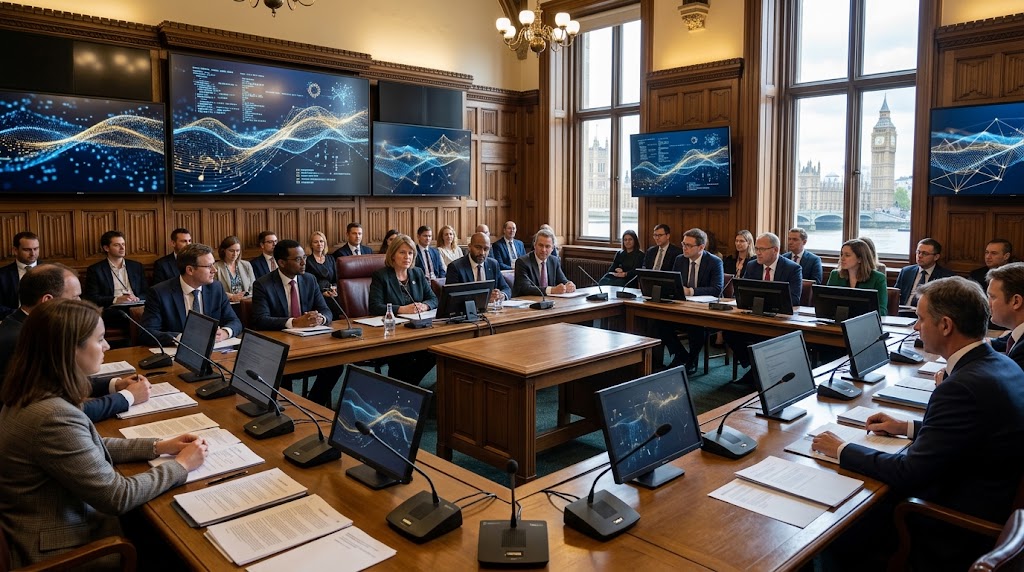
Lawmakers have invited senior executives from leading artificial intelligence developers to appear before a parliamentary committee on 13 October. Disclaimer: This image is generated by artificial intelligence.
Parliament summons OpenAI, Anthropic, Google DeepMind, and Meta over fears UK artificial intelligence rules fall short
Leading artificial intelligence developers have been called to give evidence to a parliamentary committee as lawmakers express growing concern that the UK framework governing the technology is inadequate.
Liam Byrne, chair of the Business, Innovation, Science and Trade Committee, sent formal invitations to senior executives at OpenAI, Anthropic, Google DeepMind, and Meta. The executives are asked to appear before lawmakers on 13 October.
The committee plans to examine whether pre release safety testing should become a legal requirement, what conditions ought to compel a company to pause work on a powerful system, and whether regulators need direct authority to prevent unsafe technology from reaching the market.
"AI clearly has enormous potential to transform UK productivity and growth but the warnings of industry leaders and whistleblowers in recent weeks have demonstrated that the UK’s public policy framework and international agreements are not yet fit for the future," Byrne wrote.
"Trust has emerged as the core issue in our inquiry," Byrne added, referring both to public confidence in safety standards and to whether workers and businesses can thrive as deployment accelerates.
The inquiry focuses heavily on the voluntary structure of the current regulatory environment. Under present arrangements, tech companies decide when and how to grant government officials access to their advanced systems.
"Should AI companies be allowed to decide for themselves whether their models are powerful enough to require independent safety testing?" Byrne asked. "Or should pre-release safety testing be legally mandatory?"
The letters were addressed to Tom Duff Gordon, policy chief for OpenAI in Europe, the Middle East, and Africa; Pip White, head of Anthropic for the UK and Ireland; Koray Kavukcuoglu, senior vice president at Google DeepMind; and Derya Matras, vice president for Meta across Europe, the Middle East, and Africa.
The executives have been asked to confirm by 29 September that an appropriate representative will attend.
City AM approached OpenAI, Anthropic, Google DeepMind, and Meta for comment.
Lawmakers increase scrutiny on developers
The summons follows persistent pressure on ministers to strengthen oversight of frontier artificial intelligence systems following warnings from former staff and public disagreements over access to new models.
Anthropic recently launched its latest model without submitting it to the UK AI Security Institute for pre launch evaluation. The move highlighted the constraints of relying on informal cooperation.
Henry de Zoete, director of the AI Security Institute, is scheduled to give evidence to the same parliamentary committee on 13 October.
Byrne previously stated that "voluntary self-regulation is unlikely to be a sustainable safeguard for the future", noting that the UK currently lacks sufficient powers if a business chooses to disregard safety concerns and release a risky model.
His latest correspondence asks what legal rights the AI Security Institute should hold regarding access to internal safety evaluations, training data, testing methodologies, and company models.
Lawmakers are also inquiring whether a regulatory body should hold powers to "prevent deployment, require further testing or withdraw a model" if an assessment raises serious safety concerns.
The committee asked whether the firms would agree to mandatory reporting for critical issues. These issues include deceptive behavior, circumvention of safeguards, unauthorized replication, and evidence indicating potential loss of human control.
Byrne raised the issue of personal accountability, asking who within each organization is "personally accountable" when deploying a frontier system and whether developers ought to face legal liability for predictable harm.
This inquiry follows the resignation of former Anthropic researcher Jacob Coxon, who accused major artificial intelligence laboratories of "racing straight to self-improving superintelligence and gambling with our lives".
Coxon has also received an invitation to give evidence before parliament.
The government indicated that stricter regulatory options remain under consideration. OpenAI previously voiced support for stronger UK rules aimed at the small group of companies building the most advanced technology.
Byrne directly challenged the companies to clarify whether they favor slowing down progress when regulatory oversight cannot keep up.
"Do you support slowing the development or deployment of frontier models where safety testing, external oversight or regulatory capacity has not kept pace?" Byrne asked the companies. "If not, why not?"
Source: City A.M.